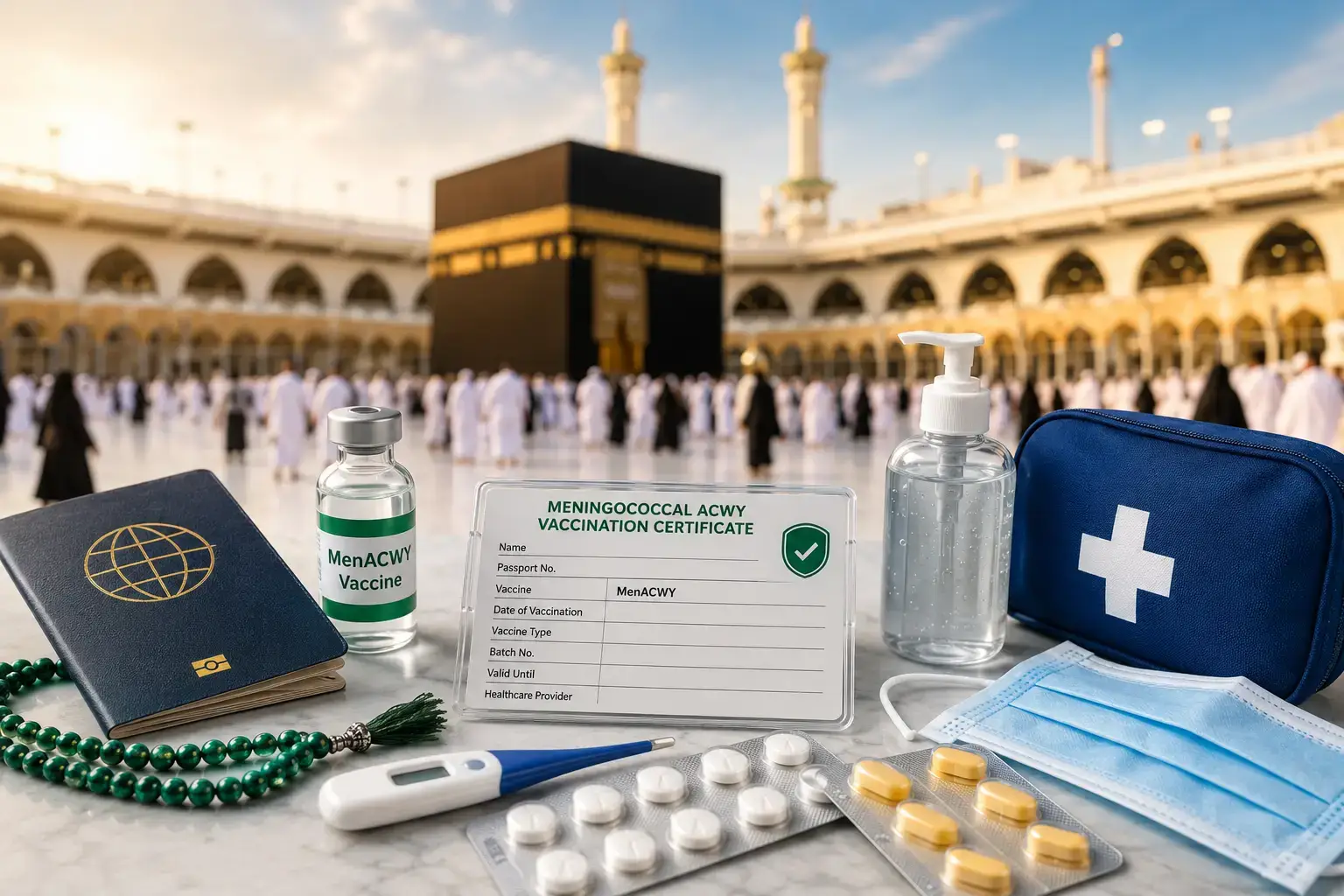
For UK pilgrims, the key distinction is between Saudi entry health requirements and vaccines or precautions that may be recommended after an individual travel-health assessment. The current Saudi 1447H (2026) requirements list meningococcal ACWY vaccination as a core requirement for Umrah and Hajj, with timing and validity rules that must be checked before travel.
This Umrah vaccination UK checklist focuses on health requirements, documents and practical precautions. For current price, certificate-service and booking information, use the MenACWY vaccination and certificate service. Rules can change, so use the latest Saudi Ministry of Health pilgrimage requirements and check them again shortly before departure.
Freshness note: the Saudi Ministry of Health page checked on 21 August 2026 still lists the 1447H (2026) Hajj requirements as its latest Hajj document. The 2026 Hajj season has passed, so do not assume those Hajj-specific health-capability or COVID-19 rules apply to Hajj 2027 until Saudi Arabia publishes the next official requirements. The current 1447H (2026) Umrah requirements remain published on the same official portal.
MenACWY vaccination and certificate rules
MenACWY protects against meningococcal groups A, C, W and Y. Saudi rules use the order ACYW, but this refers to the same four serogroups. The vaccine reduces the risk of meningococcal disease caused by these groups; it does not prevent every cause of meningitis or septicaemia.
For UK travellers, current FCDO pilgrimage advice states that a valid certificate of vaccination against the ACWY strains of meningitis is required 10 days before arriving for Hajj and Umrah. Current Saudi documents also require meningococcal vaccination for Hajj and Umrah travellers.
When must the vaccine be given?
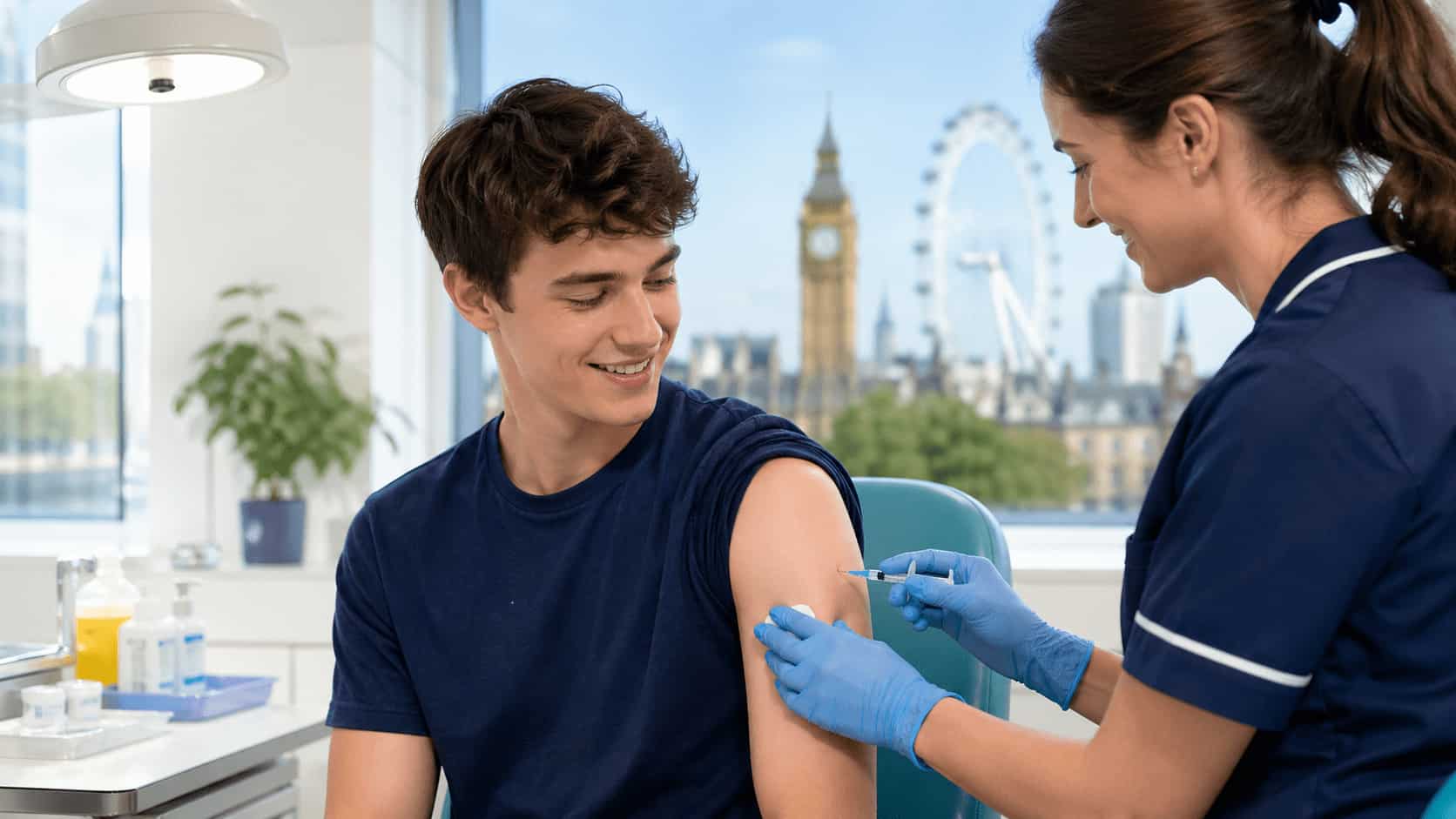
The minimum timing rule is at least 10 days before arrival in Saudi Arabia. This is a regulatory minimum, not the ideal time to start planning. Arrange a pre-travel review around four to six weeks before departure where possible so there is time to check your vaccination record, certificate, route and any additional requirements.
How long can the certificate remain valid?
Under the current 2026 Saudi rules, a quadrivalent ACYW conjugate vaccine or an ACYWX conjugate vaccine can meet the requirement when it was given within the previous five years and at least 10 days before arrival. A quadrivalent ACYW polysaccharide vaccine can meet the requirement when given within the previous three years and at least 10 days before arrival.
If the vaccine type is not recorded, Saudi guidance treats the vaccination record as valid for three years from the date it was given. Certificate validity is an entry-health rule; it should not be described as a guarantee that every person has identical immunity for the whole period.
Can a school or NHS MenACWY vaccine count?
Possibly. A previous UK MenACWY dose may still be within the relevant validity period, but the record must be sufficient for travel use. A school or NHS vaccination does not automatically create a pilgrimage certificate. Ask a travel-health professional to check the date, product or vaccine type and the documentation you intend to carry.
Route-dependent polio and yellow fever requirements
Polio and yellow fever are not universal certificate requirements for every pilgrim travelling directly from the UK. They depend on where you are arriving from and, in some cases, your recent route or stopovers.
Saudi Arabia’s current Hajj and Umrah documents list countries for which polio vaccination evidence can be required. TravelHealthPro notes that a UK Hajj pilgrim travelling directly from the UK would not normally need a polio certificate, but the rule can apply when travelling via a country affected by wild or circulating vaccine-derived poliovirus.
Yellow fever vaccination evidence can also be required when arriving from a listed yellow-fever-risk country. Give the clinician your complete itinerary rather than only the final flight from the UK, and recheck the official country lists close to departure.
COVID-19 and higher-risk travellers: Hajj and Umrah rules differ
Do not treat the Hajj and Umrah 2026 health criteria as identical. The current Saudi Umrah document explicitly requires proof of COVID-19 vaccination or immunity for specified higher-risk groups, including people over 65 years, pregnant women, and people with listed chronic heart, respiratory, kidney, blood, immune, cancer or neurological conditions. The accepted evidence is defined in the current Saudi document and can change.
The separate Hajj 1447H (2026) document also includes a COVID-19 evidence requirement for specified groups, but it additionally sets health-capability criteria for Hajj. Because the Hajj document and Umrah document are not identical, do not copy one set of criteria into the other or assume that a previous year’s Hajj rule will apply to the next season.
Hajj-specific health-capability criteria
For Hajj 2026, Saudi Arabia required countries to ensure that pilgrims did not have specified conditions that conflicted with the minimum physical ability to perform Hajj. The official list covered severe organ failure, severe neurological or psychiatric disorders that impair cognition or cause major physical disability, dementia, pregnancy in the last three months or high-risk pregnancy, active infectious diseases that pose a public-health risk in crowded settings, and active cancer being treated with therapies that severely suppress the immune system.
These are Hajj-specific official criteria, not a blanket statement that every older person or everyone with a chronic condition is unable to travel. Anyone with a significant medical condition, pregnancy, mobility problem or immune-system issue should check the current Saudi requirements and obtain individual medical advice early.
Other vaccines to review before pilgrimage
MenACWY is the central pilgrimage requirement, but it is not a complete travel-health assessment. Keep routine UK vaccinations up to date and discuss any gaps with a healthcare professional.
Routine protection may include measles, mumps and rubella (MMR) and diphtheria, tetanus and polio. A pilgrimage does not automatically mean you need an extra DTP booster; review the diphtheria, tetanus and polio vaccine service only if your record, destination risk or clinical assessment suggests it is needed.
Seasonal influenza is particularly relevant to mass gatherings and is advised in current Saudi Hajj guidance. Availability and NHS eligibility vary by season, so check the current programme rather than relying on last season’s vaccine.
Hepatitis A, typhoid and hepatitis B are not universal Saudi entry requirements for every UK pilgrim. They may be considered according to food and water exposure, accommodation, length of stay, wider itinerary, medical history and activities. Where relevant, the hepatitis A vaccine service and typhoid vaccine service provide more specific service information.
Health protection beyond vaccination
Hajj and Umrah involve close contact, shared transport, crowded worship areas, substantial walking and hot conditions. Vaccination should therefore sit alongside practical measures for respiratory infection, heat, food and water safety, animal exposure and mosquito bites.
Crowds and respiratory infections
Wash or sanitise your hands regularly, avoid sharing drinks or eating utensils, and follow current Saudi advice about face coverings in crowded settings. If you become acutely unwell before travel, seek medical advice rather than assuming you should continue with the journey.
After travel, seek urgent medical help for severe or rapidly worsening illness. Fever with severe headache, neck stiffness, confusion or a non-blanching rash needs urgent assessment; a meningococcal vaccine does not rule out all causes of meningitis or septicaemia.
Heat, hydration and physical preparation
Build up walking tolerance before travel where appropriate, plan shade and rest, drink safe fluids regularly and follow local heat warnings. People taking medicines that can worsen dehydration or affect heat regulation should discuss this with their treating clinician rather than changing treatment themselves.
MERS, food safety and insect bites
Avoid unnecessary contact with camels and raw camel products, practise good food and hand hygiene, and use safe drinking water. Use effective insect-bite prevention because dengue can occur in Saudi Arabia. Wider travel outside the main pilgrimage areas may create different health risks and should be assessed separately.
Documents and information to prepare
Take enough information for the clinic to assess both the health requirement and the documentation you will need. Useful items include your complete itinerary and stopovers, passport name, previous vaccination records, any existing MenACWY certificate, current medicines, allergies, significant medical conditions and pregnancy or breastfeeding status.
Carry the final vaccination evidence in the form required for your journey. Keep your passport and travel documents secure and retain copies. FCDO advice states that Hajj places can only be booked through the official Nusuk Hajj platform; Umrah visa options differ outside the Hajj season, so check the current entry requirements for your exact trip.
People with chronic conditions should also carry relevant medical information and enough prescribed medicine for the trip, including contingency for delays. Check medicine-entry rules separately when needed.
MenACWY vaccination, certificate and clinic booking
If you need MenACWY vaccination or a certificate review, use the MenACWY vaccination and certificate service for current service, price and booking information. This broader checklist focuses on pilgrimage requirements and practical health preparation.
Prices, stock, appointment availability and certificate inclusions can vary by clinic. Use the travel clinic directory to find a listed provider and confirm the exact service before attending. The selected clinic or pharmacy is responsible for the clinical assessment and vaccination; a booking request does not guarantee that a vaccine, certificate or appointment will be available or clinically suitable.
Check the official rules again before you travel
Pilgrimage health rules are time-sensitive. Before departure, recheck the Saudi Ministry of Health pilgrimage requirements, the TravelHealthPro Hajj and Umrah guidance and FCDO Saudi Arabia pilgrimage advice.
If Saudi Arabia publishes a new Hajj-year document, use that document for your travel dates rather than relying on the 2026 rules shown here. Vaccination, COVID-19 evidence, health-capability and route-based certificate requirements can change between seasons.
Conclusion
For UK pilgrims, MenACWY vaccination and valid documentation remain the central Hajj and Umrah health requirement in the current Saudi guidance. The dose must meet the relevant timing and validity rules, while polio, yellow fever and other requirements can depend on route, origin and individual circumstances.
Treat Hajj and Umrah as related but not identical health journeys. Hajj can carry separate capability criteria, and the current Umrah document has its own higher-risk COVID-19 evidence rules. Plan early, take complete records, use the correct service page for MenACWY booking, and recheck official Saudi and UK guidance before travel.
Written by the TravelJabs4U Editorial Team. Medically reviewed by Mohammed Shajan Ali, MPharm, GPhC-registered pharmacist (GPhC No. 2067785).
Frequently Asked Questions
Is MenACWY vaccination required for Umrah?
Yes. Current Saudi 1447H (2026) requirements state that people intending to perform Umrah must be vaccinated against meningococcal ACWY. UK FCDO advice also tells pilgrims to have a valid ACWY vaccination certificate at least 10 days before arrival.
Is MenACWY vaccination required for Hajj?
Yes. The Saudi 1447H (2026) Hajj requirements require meningococcal vaccination for Hajj pilgrims, with the vaccine given at least 10 days before arrival and within the applicable validity period.
How long can a MenACWY certificate be valid?
Under the current 2026 Saudi rules, a conjugate ACYW or ACYWX vaccine can meet the requirement when given within the previous five years. A polysaccharide ACYW vaccine can meet it when given within the previous three years. If the vaccine type is not stated, the record is treated as valid for three years.
Can I use a MenACWY vaccine I received at school or through the NHS?
Possibly, if the dose is still within the applicable validity period and the record contains enough information for travel use. A school or NHS vaccination does not automatically provide a pilgrimage certificate, so have the documentation checked before relying on it.
Do UK pilgrims need a polio or yellow fever certificate?
Usually not for direct travel from the UK solely because of pilgrimage. These requirements are route- and origin-dependent, so they can apply if you arrive from or travel via countries listed in the current Saudi rules.
Are there extra COVID-19 rules for higher-risk Umrah travellers?
Yes, in the current 1447H (2026) Umrah document. It lists specified higher-risk groups, including people over 65, pregnant women and people with certain chronic, immune, cancer, blood or neurological conditions, who must provide accepted COVID-19 vaccination or immunity evidence.
Are Hajj health rules the same as Umrah health rules?
No. They overlap, but the separate Saudi documents are not identical. Hajj 2026 included additional health-capability criteria as well as its own COVID-19 requirement for specified groups. Always use the current document for the pilgrimage you are undertaking.
Where can I arrange MenACWY vaccination and a certificate in the UK?
Use the TravelJabs4U MenACWY vaccination and certificate service for service-specific information, then confirm the exact vaccine, certificate format, price, stock and appointment availability with the selected clinic or pharmacy.
Disclaimer
This page provides general pilgrimage and travel-health information and is not an individual medical assessment or a guarantee of entry to Saudi Arabia. Hajj and Umrah requirements can change and may differ by pilgrimage, route, country of origin, age and health status. Vaccine and medicine suitability depends on your clinical history and current guidance. Prices, stock, appointment availability and certificate inclusions vary by clinic. Check current official Saudi and UK guidance before travel and seek urgent medical help for severe or rapidly worsening symptoms.