Most UK travellers do not automatically need a Japanese encephalitis vaccine for India. A short city holiday usually involves very low risk, but longer stays in rural areas, frequent travel and substantial outdoor mosquito exposure can make vaccination worth discussing.
The important questions are not simply whether Japanese encephalitis occurs in India, but where you will sleep, what you will do outdoors and whether your itinerary includes rice-growing areas, wetlands or places where pigs are kept. India is geographically diverse, and a district name alone cannot describe your personal exposure.
This guide compares practical itineraries, explains the role of seasons and rural environments, and sets out when a UK pre-travel health assessment may identify a reason to vaccinate. Vaccination is a selective clinical decision, not a routine entry requirement for everyone travelling to India.
Is Japanese Encephalitis a Risk for Travellers Visiting India?
Yes. Japanese encephalitis (JE) occurs in India, although infection is very rare among most short-term international visitors and individual risk changes with destination, season, duration and activities.
Does India Still Have Japanese Encephalitis?
Yes. Japanese encephalitis virus circulates in India, with transmission associated particularly with environments where suitable mosquitoes and animal hosts are present. This does not mean that every traveller or every part of a state presents the same risk.
The infection is caused by Japanese encephalitis virus, a flavivirus transmitted to people by infected mosquitoes. It is distinct from meningitis and from more familiar mosquito-borne illnesses such as dengue and malaria.
How Common Is Japanese Encephalitis Among Travellers to India?
Japanese encephalitis is rare in international travellers. TravelHealthPro estimates fewer than one reported case per million travellers from non-affected countries to Asia overall. This is a regional estimate, not a measured infection probability for a particular India holiday.
For an individual, the practical question is whether the journey involves repeated or prolonged mosquito exposure in a relevant setting. A week in a city hotel and six weeks near irrigated farmland should not be treated as equivalent.
Why Does a Rare Infection Still Matter?
A rare infection can still have serious consequences. Most JE infections cause no symptoms, but a small proportion affect the brain and can lead to severe neurological illness. This is why clinicians weigh the potential severity of disease against the likelihood of exposure.
Is Japanese Encephalitis Vaccination Required to Enter India?
No. Japanese encephalitis vaccination is not a standard Indian entry-certificate requirement for visitors from the UK. The reason to consider it is personal protection during travel with relevant exposure, not compliance with a general entry rule.
Which Areas of India Have Japanese Encephalitis Risk?

Japanese encephalitis transmission has been reported across many Indian states, but the greatest practical concern for visitors is exposure in rural environments with rice cultivation, standing water and suitable animal hosts. State-level reports cannot establish the risk at a particular address.
Which Indian States Have Reported Japanese Encephalitis?
Reported transmission includes parts of states such as Assam, Bihar, Uttar Pradesh, West Bengal, Odisha, Karnataka, Kerala and Tamil Nadu. These examples illustrate geographic breadth; they are not a ranked list and do not imply that all districts have equal transmission.
The CDC publishes a country-by-country risk-area summary. Travellers should use updated official guidance to establish whether their planned areas and activities are relevant rather than relying on a colour-coded map with unsupported local boundaries.
Why Are Rice Fields and Irrigated Farmland Relevant?
Rice fields and irrigation channels can support mosquitoes involved in JE transmission. The Government of India’s vector-control programme identifies the *Culex vishnui* group as important in India and describes mosquito breeding in vegetated water such as paddies, canals and shallow pools.
An agricultural visit therefore deserves more consideration if it involves repeated exposure outdoors, particularly around dusk and overnight. Walking past a rice field once is not equivalent to camping or working nearby for weeks.
Can Pig Farms and Wetlands Increase Exposure?
They can be relevant to the transmission cycle. Pigs may amplify the virus, while certain water birds are involved in its natural circulation. Mosquitoes connect those hosts to human infection; ordinary proximity to an animal is not itself proof of an infected bite.
Are Delhi, Mumbai and Other Cities Free of JE Risk?
No location can be described as completely risk-free, but short visits focused on major cities generally have a much lower JE exposure profile than prolonged rural agricultural stays. Overnight accommodation, nearby mosquito habitats and excursions beyond the city still matter.
Does Staying in a City Remove the Need to Consider Your Activities?
No. A city-based traveller who takes extended rural excursions or regularly stays outdoors after sunset may have different exposure from someone whose visit stays entirely within urban accommodation.
Is There a Reliable Japanese Encephalitis Risk Map for India?
Official risk-area summaries show where JE has been reported, but a map cannot calculate an individual traveller’s likelihood of infection. A useful India JE risk map should identify its source and date and explain that surveillance coverage and local exposure vary.
Avoid interpreting blank areas on a map as proven safety. If an itinerary includes a rural district, ask about the actual setting: irrigated land, animal-rearing areas, evening activity, length of stay and mosquito protection.
When Is Japanese Encephalitis Season in India?
Japanese encephalitis can occur throughout the year in parts of India, with transmission often increasing during and after monsoon periods. Timing varies between regions, so no single national “safe season” applies to every itinerary.
Does Monsoon Travel Increase Japanese Encephalitis Risk?
Monsoon and post-monsoon conditions can favour mosquito breeding where water collects or irrigation remains widespread. They may therefore increase exposure in affected rural areas, although rainfall alone does not determine whether vaccination is needed.
Which Months Have More Japanese Encephalitis Activity in India?
CDC country guidance identifies May to November as an important peak period, especially in northern India, while acknowledging longer or year-round transmission in some southern areas. The exact timing of a visit should be assessed alongside its location and activities.
Can Japanese Encephalitis Occur Outside the Main Monsoon Period?
Yes. Seasonal peaks do not mean that transmission ends completely outside those months. Travellers visiting an affected area during another part of the year still need sensible mosquito-bite precautions.
Does Travelling During Monsoon Automatically Mean You Need Vaccination?
No. A short city visit during monsoon may remain low exposure, while a rural camping trip at another time could justify assessment. Vaccination decisions should combine time of year with the actual itinerary.
Do You Need a JE Vaccine for a Short Trip to India?
Most people taking a short, mainly urban India holiday will not routinely need JE vaccination, but a short journey involving substantial rural mosquito exposure may warrant a different recommendation.
Is Vaccination Needed for a One- or Two-Week City Holiday?
Usually not when the journey stays largely within urban areas and accommodation with effective mosquito protection. That assessment can change when night-time rural visits, camping or agricultural work form a significant part of the trip.
Does a Golden Triangle Holiday Normally Require JE Vaccination?
A short Delhi–Agra–Jaipur itinerary based on conventional urban sightseeing is usually lower exposure. Adding several nights in a farming village or outdoor rural work changes the clinical questions.
Is Vaccination Needed for Goa or Kerala?
Not automatically. These states include different urban, coastal and rural environments. A short resort stay does not imply the same mosquito exposure as a long homestay or outdoor project near wetland and agricultural habitats.
Can Short Rural Camping or Fieldwork Change the Recommendation?
Yes. Spending even less than one month near rice fields or pig-rearing areas, especially outdoors in the evening, may justify considering vaccination. How much time is spent in the exposure setting matters more than the label “short holiday”.
Does One Rural Day Trip Mean You Need a Vaccine?
Not necessarily. A single daytime excursion usually presents a different exposure profile from repeated overnight stays, so it should be described accurately during the travel-health consultation rather than treated as an automatic indication.
| Illustrative itinerary | JE vaccination question |
|---|---|
| A week mainly in Delhi and Agra | Usually very low JE exposure; routine vaccination often unnecessary |
| Two weeks including repeated rural camps | Discuss level of mosquito exposure, especially evenings and nights |
| Six-week village stay near irrigated farms | Consider vaccination, season and sleeping conditions |
| Repeated visits to relatives in rural districts | Review cumulative exposure and previous vaccinations |
| Outdoor agricultural fieldwork | Exposure pattern may justify vaccination even on a shorter trip |
Which Travellers Should Consider JE Vaccination for India?
Vaccination can be considered for travellers spending a month or more in affected areas during transmission periods, making repeated visits, following uncertain itineraries or having substantial rural and night-time mosquito exposure.
Should Travellers Staying for a Month or Longer Consider Vaccination?
Yes. A stay of one month or more in an affected area during transmission season is a recognised reason to consider JE vaccination. The decision still depends on the precise environment, travel activities and individual clinical factors.
Can Higher-Exposure Trips Lasting Under a Month Qualify?
Yes. Fieldwork, camping, farming or extensive outdoor activity near relevant mosquito habitats can change the assessment even when the itinerary is shorter than four weeks.
Are Agricultural Workers, Volunteers and Researchers More Exposed?
They may be, particularly when their work involves regular evenings outdoors near irrigation channels, rice paddies, wetlands or animal-rearing areas. Workplace protective arrangements should also be considered.
Should Children Travelling to Rural India Be Assessed?
Yes. Children with meaningful exposure should receive an age-appropriate travel-health assessment. The vaccine chosen, licensed age limits and practical mosquito-protection measures require professional guidance rather than assumptions based on the adult schedule.
What if Your India Itinerary Is Uncertain?
Uncertainty can support considering vaccination when rural destinations, accommodation and duration may change after departure. Discuss the range of likely plans rather than giving the clinician only the first city on your ticket.
Does Visiting Family in Rural India Change JE Risk?
It can, especially when family visits involve repeated or extended stays in affected rural communities, unscreened sleeping arrangements or outdoor evening activities. Staying with relatives alone does not make a person high risk.
Can Longer Visits With Relatives Increase Exposure?
Yes. A traveller who spends several weeks near agricultural land may encounter mosquitoes more often than someone making a brief city visit. Regular returns can also make a previous assessment out of date if travel habits change.
Does a Rural Family Home Automatically Mean High Risk?
No. Household location, screening, nearby water and the amount of time outdoors are more informative than whether the home belongs to family. For people visiting family in India for longer stays, accommodation and evening routines are useful details to bring to a travel-health appointment.
How Is Japanese Encephalitis Transmitted in India?
Japanese encephalitis is transmitted to humans by infected mosquitoes, principally certain *Culex* species, through a cycle involving mosquitoes and animal hosts such as pigs and water birds.
Which Mosquitoes Spread Japanese Encephalitis in India?
Mosquitoes in the *Culex vishnui* group are recognised vectors in India. Many breed in vegetated standing water and are particularly active around dusk and at night, although mosquito activity can vary with conditions.
What Role Do Pigs and Water Birds Play?
Pigs may amplify the virus and certain birds act as natural hosts. Mosquitoes acquire infection during feeding and can then pass it to people, who are incidental hosts rather than an important source of onward transmission.
Can Japanese Encephalitis Spread Between People?
Ordinary person-to-person contact does not spread Japanese encephalitis. The usual route is an infected mosquito bite, so practical prevention focuses on mosquitoes rather than avoiding social contact.
Can You Catch JE From Touching a Pig?
Ordinary handling or proximity is not the usual transmission route. The main infection risk is from mosquitoes that participate in the animal–mosquito transmission cycle.
How Can Travellers Prevent Japanese Encephalitis?
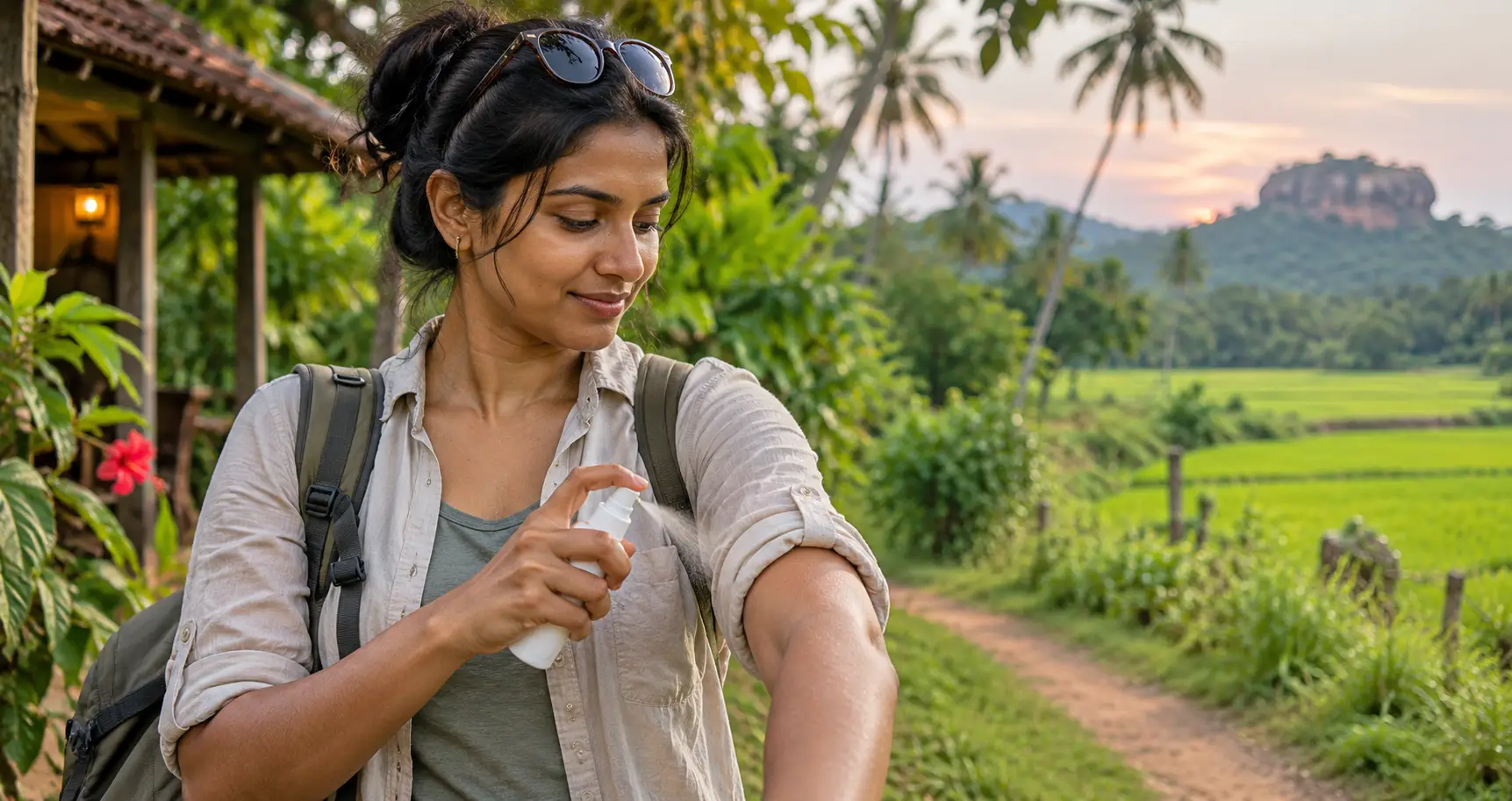
Mosquito-bite prevention matters for everyone visiting relevant areas, whether or not JE vaccination is recommended. Focus on effective repellent, protective clothing and sleeping arrangements that reduce bites between dusk and dawn.
Which Repellents Help Reduce Mosquito Bites?
Use an effective repellent, such as an appropriate DEET-containing product, on exposed skin in line with the manufacturer’s directions. Apply it consistently during periods of outdoor exposure rather than waiting until mosquitoes are obvious.
Can Clothing Reduce Exposure?
Yes. Long trousers, covered ankles and long sleeves help reduce skin available for biting, particularly during outdoor evenings and in agricultural settings.
Are Nets and Screened Accommodation Useful?
Yes. Insecticide-treated mosquito nets, well-fitted window screens or appropriately protected rooms can reduce overnight exposure. Accommodation quality matters most where mosquitoes are active around sleeping areas.
Is Mosquito Protection Necessary After Vaccination?
Yes. Vaccination does not provide guaranteed protection or prevent dengue, malaria and other mosquito-borne infections. Effective mosquito-bite prevention for rural India travel remains important for the entire itinerary, including time spent away from agricultural areas.
Does JE Vaccination Protect Against Dengue or Malaria?
No. These diseases involve different pathogens and prevention approaches. A JE vaccine is not a substitute for destination-specific malaria assessment or protection from daytime-biting mosquitoes associated with dengue.
What Does JE Vaccination Protect Against?
Japanese encephalitis vaccination is intended to reduce the risk of disease caused by JE virus in travellers with relevant exposure, but it cannot eliminate risk or replace mosquito-bite precautions.
Is JE Vaccination Necessary for Everyone Going to India?
No. India is a large country with very different itineraries. Vaccination is considered selectively, particularly for prolonged rural exposure or shorter higher-risk trips, rather than automatically for every visitor.
How Many JE Vaccine Doses Are Usually Required?
The UK-licensed IXIARO vaccine normally uses a two-dose primary course. Age, the time available before exposure and previous vaccination determine which licensed schedule a clinician can recommend; detailed dosing belongs with the vaccine service information.
When Should a Traveller Arrange a JE Assessment?
Ideally four to six weeks before travel, or earlier for complicated itineraries, so there is time to review exposure and any recommended course. Advice is still worthwhile when departure is closer.
How Much Does Japanese Encephalitis Vaccination Cost in the UK?
Japanese encephalitis vaccination is generally paid for privately when needed for travel in the UK. Japanese encephalitis vaccine costs can vary by clinic and by whether the charge applies to one dose or a complete course, so the selected provider should confirm the total before an appointment.
What Symptoms of Japanese Encephalitis Need Medical Attention?
Most infections cause no symptoms, but fever followed by confusion, seizures or other neurological problems requires urgent medical assessment because severe Japanese encephalitis can inflame the brain.
What Are Possible Early Symptoms?
When illness occurs, it may begin with a high temperature, headache, vomiting or general weakness. These signs are not specific to JE, and other infections can cause similar illness after travel.
Can JE Cause Encephalitis and Lasting Complications?
Yes. In a minority of infections, inflammation of the brain can cause seizures, altered consciousness and potentially lasting neurological harm. This seriousness is one reason higher-exposure travellers may benefit from vaccine assessment.
When Should Travellers Seek Emergency Help?
Seek emergency medical care for fever with confusion, seizures, loss of consciousness or other significant neurological symptoms. Tell the treating team about recent travel to India and any rural or mosquito exposure.
How Does JE Fit Into India Travel Vaccination Planning?
Japanese encephalitis is a selective consideration within a wider India travel-health assessment. Routine vaccinations, food- and water-borne infections, animal exposures and malaria prevention may raise different questions depending on the itinerary.
Which Other Vaccinations Should UK Travellers Review?
The appropriate travel vaccinations for India depend on earlier doses, health conditions, destination and activities. Hepatitis A, typhoid and routine UK immunisations may be discussed alongside more selective vaccines such as JE or rabies.
Are JE, Malaria and Dengue the Same Risk?
No. Although all involve insect exposure, JE is a viral infection involving particular mosquitoes and animal hosts, dengue involves a different virus and mosquito pattern, and malaria is caused by parasites. Each needs its own risk assessment.
What Should Travellers Discuss Before an India Travel-Health Appointment?
A useful appointment covers the states and districts being visited, travel dates, rural overnight stays, planned outdoor activity, accommodation, medical history and previous immunisation records.
Which Itinerary Details Help Assess JE Risk?
The most useful details are where you will sleep, how many nights are rural, whether you will visit paddies or animal-rearing areas, and how much time you will spend outdoors at dusk and overnight.
What if You Are Leaving for India Soon?
An assessment is still worthwhile. A clinician can explain any vaccine options appropriate to your circumstances and help you plan mosquito protection even when the standard schedule cannot be completed before departure.
Should Repeat Travellers Bring Old Vaccine Records?
Yes. An accurate record of prior JE and other travel vaccinations helps avoid unnecessary repeat doses and supports the correct advice if exposure is expected to continue.
Frequently Asked Questions About Japanese Encephalitis Vaccination for India
The need for vaccination depends on the individual journey. These concise answers cover common questions from UK travellers deciding whether to discuss JE vaccination.
Do All UK Travellers Need a Japanese Encephalitis Vaccine for India?
No. Vaccination is selective. Most short, low-exposure urban visits have very low JE risk, while longer rural stays, uncertain itineraries or substantial outdoor mosquito exposure may justify assessment.
Is Japanese Encephalitis Present Throughout India?
JE transmission is recognised across many parts of India, but risk differs by region, season and setting. A national statement does not establish risk at a particular district, hotel or village.
Is JE Vaccination Needed for a Two-Week India Holiday?
Usually not for a short urban-focused holiday. A two-week journey involving rural camping, farm visits or extensive evening outdoor activity may warrant a different assessment.
Which Areas of India Have Japanese Encephalitis Risk?
Reported areas include several states in northern, eastern and southern India. Rural rice-growing and irrigated environments are particularly relevant, but no simple state ranking predicts individual traveller risk.
Is JE More Common During the Monsoon in India?
Transmission commonly increases during and after monsoon periods, especially in northern India. Some regions have extended or year-round activity, so season is only one part of the decision.
Do You Need a Japanese Encephalitis Vaccine for Goa or Kerala?
Not automatically. A short resort-based itinerary differs from prolonged rural stays or agricultural activity. The exact locality, season and accommodation should inform the assessment.
Can Children Receive Japanese Encephalitis Vaccination?
Age-appropriate JE vaccination can be considered for children with meaningful exposure risk. The clinician must confirm suitability and the licensed schedule for the child.
Can You Still Get Japanese Encephalitis After Vaccination?
Vaccination reduces the risk of disease but cannot guarantee complete protection. Travellers should continue using effective mosquito-bite prevention.
Is Japanese Encephalitis Vaccination Required for Entry to India?
No. JE vaccination is not a general entry-certificate requirement for India. It is considered for personal health protection when travel exposure justifies it.
Key Advice for UK Travellers Considering JE Vaccination
Most short urban holidays in India involve very low JE risk, but travellers staying for longer periods in affected rural areas or expecting substantial mosquito exposure should discuss vaccination before departure. The safest decision starts with an accurate itinerary, not the assumption that all visitors need the same vaccine.
If your plans include farm stays, rice-growing districts, prolonged family visits or outdoor work, a travel-health professional can weigh vaccination against the likely exposure. Suitable mosquito precautions are important whether or not a vaccine is recommended.
Medical Information
This article provides general travel-health information for UK travellers and does not replace an individual clinical assessment. Vaccine suitability, course timing and mosquito exposure depend on the precise itinerary, age, health history and current guidance. Seek urgent medical care for severe neurological symptoms during or after travel.
Guidance sources: TravelHealthPro (India and Japanese encephalitis), NHS (Japanese encephalitis), UKHSA Green Book chapter 20, CDC Yellow Book (India) and Government of India vector-control information. A qualified healthcare professional should review the individual itinerary and any recommended vaccination before departure.
About the Author