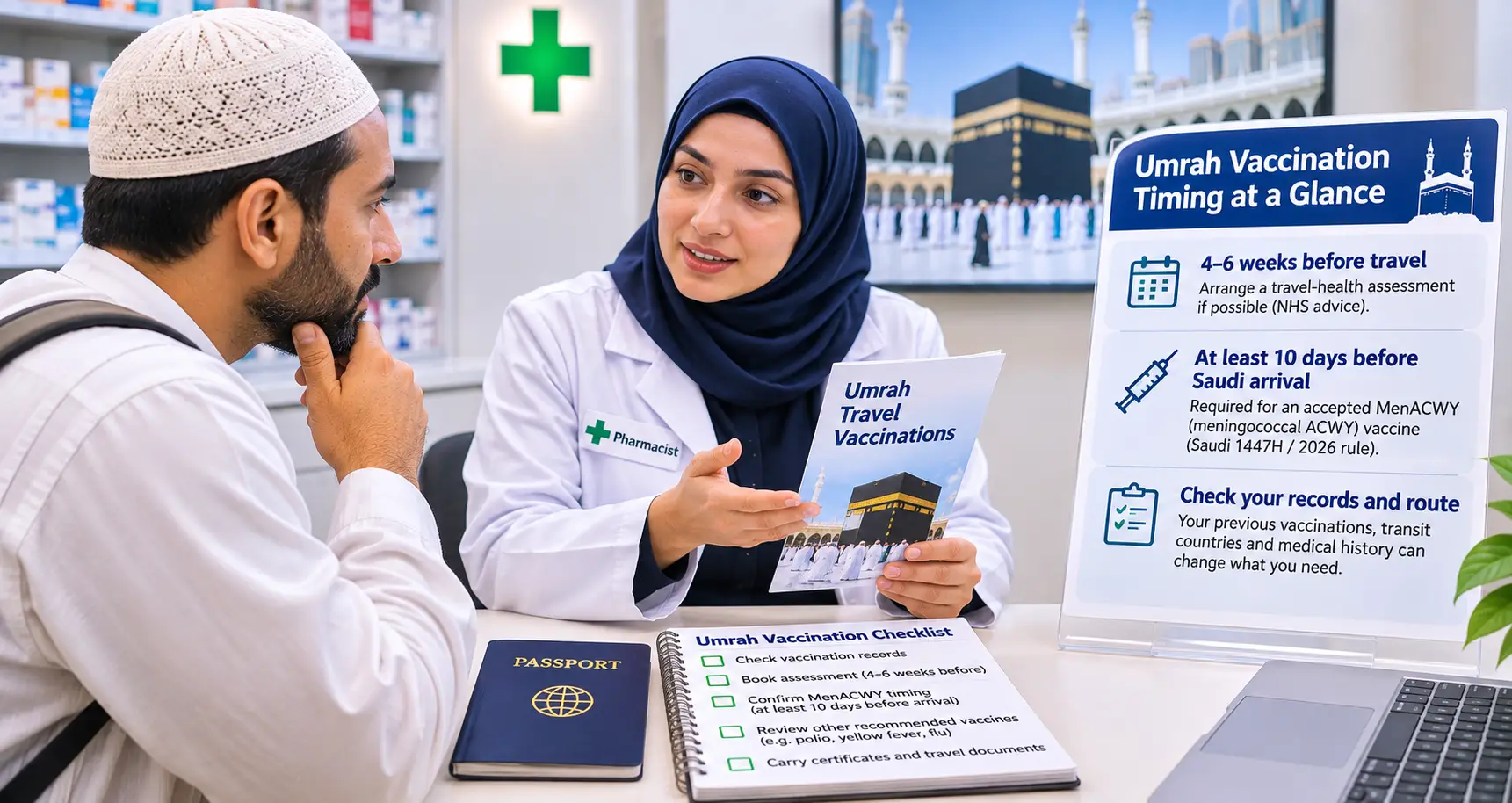
Umrah vaccination requirements for UK pilgrims include mandatory meningococcal ACWY (MenACWY) vaccination at least 10 days before arrival in Saudi Arabia. Under the Saudi Ministry of Health’s 1447H (2026) regulations, additional polio, yellow fever and COVID-19 vaccination or immunity requirements apply to travellers from specified countries or medical-risk groups.
The meningococcal vaccine protects against four groups of bacteria associated with serious meningococcal disease, including meningitis and septicaemia. Saudi Arabia requires vaccination because the close contact associated with large religious gatherings can increase opportunities for infectious diseases to spread.
For UK travellers, meeting these requirements involves more than arranging a vaccination appointment. Pilgrims should also check previous immunisation records, vaccine validity periods, certificate details, international travel routes and individual health considerations.
This guide explains which vaccinations are compulsory for Umrah, when to receive them, how long vaccination evidence remains valid and what to check before travelling to Makkah and Madinah.
Information checked against official 1447H (2026) Saudi guidance and UK travel-health advice on 12 October 2026. Entry requirements can change; always confirm the latest guidance before travelling.
What Are the Current Umrah Vaccination Requirements for UK Pilgrims?
The main compulsory vaccination for UK pilgrims performing Umrah is the meningococcal ACWY vaccine. However, Saudi Arabia’s entry health regulations also include additional requirements based on a traveller’s country of arrival, medical history and age.
The Saudi Ministry of Health’s document, Health Requirements and Recommendations for Travellers to Saudi Arabia for Umrah — 1447H (2026), identifies meningococcal vaccination as a requirement for all individuals intending to perform Umrah. It also specifies separate conditions involving poliomyelitis, yellow fever and COVID-19.
Which vaccines are mandatory for Umrah in 2026?
| Vaccine | Who needs it? | Timing or evidence requirement |
| Meningococcal ACWY | All individuals intending to perform Umrah | Accepted vaccine at least 10 days before arrival |
| Polio | Travellers arriving from specified countries | Accepted IPV or OPV according to the relevant country category |
| Yellow fever | Travellers older than nine months arriving from designated countries | Certificate valid from 10 days after vaccination |
| COVID-19 | Specified higher-risk Umrah travellers | Accepted vaccination or immunity evidence |
| Routine immunisations | All pilgrims | Recommended to remain up to date |
For a pilgrim travelling directly from the UK, MenACWY is usually the principal mandatory vaccination to arrange or verify.
However, a UK resident arriving from another country may face additional entry requirements. This is why travel origin and itinerary matter alongside nationality or UK residence.
What is the difference between required and recommended Umrah vaccinations?
Required vaccinations are those specified by Saudi Arabia’s health regulations for a traveller’s circumstances. Not meeting an applicable condition can cause problems with travel or entry.
Recommended vaccinations are advised to reduce health risks, even when they are not compulsory for entry.
For example, MenACWY vaccination is compulsory for Umrah pilgrims, while keeping routine immunisations up to date is a broader preventive-health recommendation.
A travel-health professional can explain which vaccinations are legally required and which are advisable for your individual journey.
Is the Meningitis ACWY Vaccine Mandatory for Umrah?
Yes. Meningococcal vaccination covering serogroups A, C, W and Y is mandatory for individuals intending to perform Umrah under Saudi Arabia’s 2026 health requirements.
The vaccine must have been administered at least 10 days before arrival and remain within the applicable validity period.
What is the MenACWY vaccine?
The MenACWY vaccine, also called the quadrivalent meningococcal vaccine, protects against meningococcal serogroups A, C, W and Y.
These are groups of Neisseria meningitidis, bacteria that can cause serious invasive meningococcal disease.
The infection can take different forms, including:
- Meningococcal meningitis: Infection affecting the membranes surrounding the brain and spinal cord.
- Meningococcal septicaemia: A serious bloodstream infection that can progress rapidly.
- Other invasive meningococcal infections: Less common infections affecting different parts of the body.
MenACWY vaccination does not prevent every cause of meningitis. In particular, it does not cover meningococcal serogroup B.
Why does Saudi Arabia require meningococcal vaccination for Umrah?
Umrah involves pilgrims from many countries gathering in crowded religious and public spaces, particularly around the holy sites in Makkah and Madinah.
Meningococcal bacteria can spread through respiratory and throat secretions during close or prolonged contact.
Crowded accommodation, shared transport and frequent interaction between pilgrims can increase opportunities for transmission.
The UK National Travel Health Network and Centre (NaTHNaC), through TravelHealthPro, reports that meningococcal disease outbreaks have occurred in association with previous Hajj and Umrah gatherings. Its guidance also highlights cases in the UK linked to pilgrimage travel during 2024 and 2025, demonstrating that the public-health implications can extend beyond Saudi Arabia.
Vaccination helps reduce the risk of disease caused by the vaccine-covered serogroups and is an important preventive measure before pilgrimage.
Who needs the MenACWY vaccine before Umrah?
Saudi Arabia’s 2026 Umrah health document specifies meningococcal vaccination for individuals intending to perform Umrah from all countries.
However, vaccine suitability and licensing differ by age and individual clinical circumstances.
Some people may already have received an accepted MenACWY vaccine through an NHS vaccination programme or previous international travel.
A previous dose may satisfy the requirement if it is within the applicable validity period and supported by suitable documentation.
For further information about the vaccine itself, see the TravelJabs4U meningococcal vaccine for Umrah guide.
When Should You Get the MenACWY Vaccine Before Umrah?
An accepted MenACWY vaccine must have been administered at least 10 days before arriving in Saudi Arabia.
However, the minimum vaccination interval should not be confused with the ideal time to arrange a travel-health appointment.
Planning several weeks ahead allows time to review records, assess vaccine suitability and arrange any additional vaccinations or documents.
How many days before Umrah should you get vaccinated?
Saudi Arabia’s 1447H (2026) health regulations specify a minimum interval of 10 days between an accepted meningococcal vaccination and arrival.
For example, a traveller planning to arrive on 20 December should not rely on a new MenACWY dose administered fewer than 10 days before that arrival date.
A practical approach is to arrange a travel-health consultation around four to eight weeks before departure.
This provides additional time to resolve missing records, check previous vaccination details and accommodate any other recommended immunisations.
How long does the meningitis vaccine last for Umrah?
Saudi Arabia uses different regulatory validity periods for accepted meningococcal vaccine types.
| Accepted vaccine type | Maximum regulatory validity |
| Quadrivalent ACWY conjugate vaccine | 5 years |
| Pentavalent ACYWX conjugate vaccine | 5 years |
| Quadrivalent ACWY polysaccharide vaccine | 3 years |
| Vaccine type not documented on certificate | Treated as valid for 3 years |
The Saudi Ministry of Health’s 2026 document distinguishes between quadrivalent ACWY conjugate, pentavalent ACYWX conjugate and quadrivalent ACWY polysaccharide vaccines. Conjugate vaccines are accepted when administered within the previous five years, while the polysaccharide vaccine is subject to a three-year period. Each accepted vaccination must also have been administered at least 10 days before arrival.
These validity periods determine whether a vaccination meets the stated travel requirement. They should not be interpreted as a guarantee of immunity throughout the entire period.
Can I use a MenACWY vaccine received previously through the NHS?
Yes, a previous NHS MenACWY vaccination may be acceptable if it meets Saudi Arabia’s vaccine-type, timing and documentary requirements.
In the UK, MenACWY vaccination is included in the adolescent immunisation programme.
If you received a dose at school, university or during a previous travel consultation, ask your GP practice or vaccination provider to help verify the record.
The important details are the vaccine type, vaccination date and acceptable evidence.
A clinician can determine whether the previous dose is suitable or whether another vaccination should be considered.
Do UK Pilgrims Need an Umrah Vaccination Certificate?
UK government pilgrimage guidance requires travellers to have a valid certificate of vaccination against meningococcal ACWY before arriving for Umrah.
Although the Saudi 2026 document specifies additional certificate conditions for travellers from particular countries, its underlying meningococcal vaccination requirement applies to all Umrah pilgrims.
The UK’s Foreign, Commonwealth & Development Office, in its official Saudi Arabia: Pilgrimage travel advice, states that Hajj and Umrah travellers must have valid evidence of vaccination against the ACWY strains of meningitis at least 10 days before arrival. UK pilgrims should therefore check their vaccination documents before departure rather than assuming a previous vaccine dose is sufficient without supporting records.
What information should appear on your vaccination certificate?
Your vaccination documentation should clearly identify:
- Your full name, matching your travel identification.
- The name of the vaccine administered.
- The vaccine type, including whether it is conjugate or polysaccharide.
- The date of administration.
- The administering healthcare professional or vaccination provider.
- Any appropriate authentication or supporting details required by current guidance.
TravelHealthPro recommends that the patient-held record should show the individual’s full name and vaccine details, with appropriate authentication from the healthcare provider.
Including the vaccine type is especially important because an unspecified type is treated under the shorter three-year validity period in the Saudi requirements.
Can you use an NHS vaccination record as proof?
An NHS vaccination record can help demonstrate that you have received MenACWY, but its suitability as travel evidence depends on the information recorded and applicable requirements.
A record containing the vaccine name, type, date and patient details may be useful.
If important information is missing, contact the original vaccination provider before departure.
A travel clinic or qualified healthcare professional can advise whether additional documentation is needed.
What happens if you lose your Umrah vaccination certificate?
If you lose your vaccination certificate, contact the GP practice, pharmacy or clinic that administered the vaccine.
The provider may be able to retrieve the vaccination record or explain the available documentation options.
Do not automatically book another dose before checking your previous immunisation history.
A replacement record should accurately reflect the vaccine that was actually administered.
Does a Saudi tourist visa remove the vaccination requirement?
No. Visa eligibility and health-entry requirements are separate.
A tourist e-visa or another form of entry permission does not remove the requirement to comply with applicable vaccination rules when performing Umrah.
Travellers should review both their visa conditions and the current pilgrimage health regulations before departure.
Are Polio, Yellow Fever and COVID-19 Vaccines Required for Umrah?
Polio, yellow fever and COVID-19 requirements do not apply universally in the same way as MenACWY vaccination.
The Saudi Ministry of Health specifies conditions based on particular countries or medical-risk groups.
For UK pilgrims, the important distinction is whether the additional requirement applies to their actual circumstances.
Do UK pilgrims need a polio vaccination for Umrah?
People travelling directly from the UK are not normally subject to the additional country-specific polio vaccination requirement.
However, travellers arriving from specified countries may need to present evidence of vaccination with an accepted inactivated polio vaccine (IPV) or oral polio vaccine (OPV).
The Saudi Ministry of Health’s 2026 Umrah regulations identify Afghanistan and Pakistan among countries subject to mandatory polio vaccination requirements. The document also lists other countries under categories involving circulating vaccine-derived poliovirus. Different vaccine arrangements apply to these categories, making it important to check the official country lists rather than assuming one polio rule covers every international traveller.
For example, a UK resident who has recently stayed in Pakistan should obtain travel-health advice about their route and applicable documentation.
Being a British passport holder does not automatically determine which country-specific health regulations apply.
Is the yellow fever vaccine required for Umrah from the UK?
Yellow fever vaccination is not normally required solely because a pilgrim is travelling directly from the UK.
However, Saudi Arabia requires valid yellow fever vaccination evidence from travellers arriving from designated countries.
The Saudi Ministry of Health’s 2026 Umrah health regulations identify specific countries in Africa and South America whose arriving travellers must meet yellow fever vaccination requirements. For applicable travellers older than nine months, a yellow fever vaccination certificate becomes valid 10 days after vaccination and remains valid for life.
This means a traveller arriving directly from the UK may have different requirements from someone arriving from a yellow-fever-risk country.
Travellers with international stopovers should obtain advice about how the rules apply to their journey.
Is COVID-19 vaccination compulsory for Umrah in 2026?
COVID-19 vaccination or accepted immunity evidence is required for specified higher-risk Umrah pilgrims under Saudi Arabia’s 2026 health regulations.
These include:
- People over 65 years of age.
- Pregnant women.
- People with chronic heart or respiratory diseases.
- People with chronic kidney failure.
- People with specified hereditary blood disorders.
- People with certain immunodeficiency conditions.
- People with cancer or specified chronic neurological diseases.
The Saudi Ministry of Health’s 1447H (2026) Umrah document identifies qualifying forms of evidence, including a dose of an updated 2025–2026 COVID-19 vaccine, completion of a qualifying primary vaccination series during 2021–2024, or laboratory-confirmed recovery from infection during 2025.
The regulation does not establish the same COVID-19 evidence requirement for every pilgrim.
Travellers in an affected group should review their records and consult current official guidance before departure.
Which Other Vaccinations Are Recommended Before Umrah?
Mandatory vaccination requirements do not cover every infection that travellers may encounter.
Before visiting Saudi Arabia, UK pilgrims should review routine immunisations and consider whether additional protection is appropriate for their age, medical circumstances and journey.
Is the flu vaccine recommended for Umrah pilgrims?
Seasonal influenza vaccination may be advisable, particularly for older adults, pregnant women and people with underlying medical conditions.
Influenza spreads through respiratory particles and can circulate in crowded environments.
Pilgrims frequently spend time in busy accommodation, transport hubs and religious gathering areas.
The UK’s TravelHealthPro pilgrimage guidance highlights respiratory infections as a concern during mass gatherings. Its recommendations encourage travellers to review their individual health risks and follow appropriate preventive measures.
Ask your healthcare professional whether seasonal influenza vaccination is appropriate for your circumstances and travel dates.
Which routine vaccinations should UK travellers check?
Routine vaccinations may include:
- Measles, mumps and rubella (MMR).
- Diphtheria.
- Tetanus.
- Pertussis (whooping cough).
- Polio.
- Chickenpox, where clinically appropriate.
The Saudi Ministry of Health’s 2026 pilgrimage guidance recommends remaining up to date with routine immunisation schedules, including protection against diphtheria, tetanus, pertussis, poliomyelitis, measles, chickenpox and mumps.
A vaccination assessment can identify whether any routine doses or boosters are due according to UK recommendations.
Are hepatitis B or other travel vaccines necessary?
Not every pilgrim needs additional travel vaccines.
However, healthcare professionals may consider hepatitis B vaccination for travellers with relevant exposure risks, particularly where procedures involving needles or other potential blood exposures are anticipated.
Individual advice may also cover rabies prevention or other destination-specific risks depending on travel activities.
These are clinical recommendations rather than universal Umrah vaccination requirements.
Do Children, Pregnant Women and Older Adults Have Different Umrah Vaccination Needs?
Umrah vaccination regulations apply within the context of a traveller’s age, vaccine suitability and medical circumstances.
People with additional health needs may benefit from an earlier consultation.
Do children need the meningitis vaccine for Umrah?
Children should receive an age-appropriate travel vaccination assessment before Umrah.
Saudi Arabia’s 2026 regulations specify a general MenACWY requirement for people intending to perform Umrah, but vaccine product authorisations and clinical schedules can differ by age.
For infants and younger children, a healthcare professional should check both the applicable official travel requirement and the suitability of available vaccines.
Parents should avoid leaving this assessment until the final days before departure.
Can pregnant women receive Umrah vaccinations?
Pregnant women should discuss vaccination and pilgrimage plans with a qualified healthcare professional.
The safety and suitability of a particular vaccine depend on the vaccine type, pregnancy circumstances and individual medical history.
Saudi Arabia’s 2026 Umrah regulations include pregnant women among the groups requiring accepted COVID-19 vaccination or immunity evidence.
A consultation should also consider hydration, heat exposure, mobility and access to suitable medical care during the journey.
What should older pilgrims consider before travelling?
Older pilgrims may need additional preparation because chronic medical conditions, medicines and prolonged physical activity can increase travel-health risks.
The Saudi Ministry of Health identifies travellers older than 65 as one of the groups subject to its 2026 COVID-19 evidence requirement.
People with chronic illnesses should consult their usual healthcare professional and carry appropriate medical documentation.
Their vaccination history should also be reviewed well before departure.
What if you have a weakened immune system?
People with weakened immunity may face a greater risk of complications from certain infections.
Vaccine selection, effectiveness and scheduling can differ depending on the underlying condition or treatment.
Some travellers may require specialist advice about whether a particular vaccination is suitable and whether additional precautions are necessary.
Discuss your pilgrimage plans with your treating clinician before arranging travel.
Where Can You Get Umrah Vaccinations in the UK?
UK pilgrims can seek MenACWY vaccination through eligible travel vaccination clinics, pharmacies and healthcare providers.
The services available may include vaccination assessment, immunisation record review and appropriate documentation.
Can you get the Umrah meningitis vaccine through the NHS?
Some travellers may already have received MenACWY through an NHS vaccination programme.
However, vaccines needed specifically for travel are not automatically provided free of charge through the NHS.
Availability and eligibility depend on the vaccination service and clinical circumstances.
If you were vaccinated previously, checking your NHS record may help avoid an unnecessary repeat dose.
Can a private travel clinic provide the MenACWY vaccine?
Private travel clinics and eligible pharmacies may provide MenACWY vaccination for people preparing for Umrah.
Before booking, confirm that the provider offers an accepted vaccine and can explain the relevant documentation arrangements.
This allows pilgrims to explore the vaccination service separately from the broader entry requirements explained in this guide.
What should you bring to your vaccination appointment?
Bring your available vaccination records, travel itinerary, planned arrival date and relevant medical information.
You may also need identification details to ensure vaccination documentation is accurate.
Tell the healthcare professional about previous international travel, stopovers, allergies, medicines and significant health conditions.
These details help determine which vaccinations and supporting records are relevant.
What Happens If You Miss the Umrah Vaccination Deadline?
If you have not received an accepted MenACWY vaccine at least 10 days before arrival, you may not meet Saudi Arabia’s minimum vaccination interval.
Receiving the vaccine immediately before departure does not automatically remove this requirement.
Contact a healthcare professional promptly to review any previous vaccination records.
If you have not previously received an accepted vaccine, check official entry requirements and discuss your options with your travel provider.
You may need to adjust your travel dates if the timing requirement cannot be met.
Are Umrah and Hajj Vaccination Requirements the Same?
Umrah and Hajj have overlapping vaccination requirements, particularly for meningococcal disease, but their official health regulations should not be treated as identical.
Umrah can generally be performed at permitted times outside the Hajj period, while Hajj takes place during a specified period of the Islamic calendar.
Saudi Arabia publishes separate health requirements for pilgrimage travel.
| Health requirement | Umrah | Hajj |
| MenACWY vaccination | Required | Required |
| Polio vaccination | Country-dependent | Check Hajj-specific rules |
| Yellow fever vaccination | Country-dependent | Check Hajj-specific rules |
| COVID-19 evidence | Required for specified groups under the 2026 Umrah rules | Check the relevant Hajj-season regulations |
| Additional health-capability conditions | Individual medical assessment may be appropriate | Separate formal conditions may apply |
Pilgrims planning Hajj should review the current Hajj health document rather than relying entirely on Umrah guidance.
How Can You Stay Healthy During Umrah in Makkah and Madinah?
Vaccination is an important preventive measure, but it does not eliminate every travel-health risk.
Pilgrims should also consider respiratory infections, high temperatures, food hygiene and the management of existing medical conditions.
How can you reduce respiratory infection risks?
Good hand hygiene, appropriate respiratory etiquette and avoiding close contact with visibly unwell people can help reduce infection risks.
Saudi Arabia’s 2026 pilgrimage health guidance recommends washing hands, using disposable tissues for coughs and sneezes, wearing face masks in crowded settings and avoiding the sharing of personal items.
Pilgrims who become unwell should seek medical advice.
Severe headache, fever, neck stiffness, unusual drowsiness or a rapidly worsening rash may indicate a serious infection requiring urgent assessment.
How can you prevent dehydration and heat-related illness?
Drink enough fluids, take regular breaks and avoid unnecessary exposure to intense heat.
The Saudi Ministry of Health’s 2026 guidance advises pilgrims, particularly older individuals, to limit direct sun exposure and maintain adequate hydration. It also notes that some medicines can worsen dehydration or affect heat regulation, and that any necessary medication adjustment should be made by the treating physician.
Never stop or change prescribed medicine without professional medical advice.
What medicines and medical documents should you carry?
Travellers with long-term medical conditions should bring sufficient prescribed medicine for the journey, allowing for potential delays.
Medicines should generally remain in their original packaging.
Carry important medical information, including details of health conditions and prescriptions, where appropriate.
Check Saudi medicine-entry rules for any medicines that may be restricted.
Umrah Vaccination Checklist Before Travelling
Use the following checklist before departing from the UK.
- Check the latest Saudi Ministry of Health requirements.
- Confirm your MenACWY vaccination date and vaccine type.
- Ensure the minimum 10-day interval is satisfied.
- Obtain suitable vaccination documentation.
- Review the regulatory validity of any previous MenACWY dose.
- Check whether your travel route creates polio vaccination requirements.
- Confirm whether yellow fever certificate requirements apply.
- Check COVID-19 evidence requirements for your medical-risk group.
- Review routine vaccinations with a healthcare professional.
- Arrange clinical advice for pregnancy, childhood travel or long-term health conditions.
- Pack prescribed medicines and relevant medical documents.
- Recheck official entry rules shortly before departure.
Frequently Asked Questions About Umrah Vaccination Requirements
1. What vaccinations are required for Umrah from the UK?
For most UK pilgrims travelling directly to Saudi Arabia, the primary compulsory vaccination is meningococcal ACWY. Additional polio or yellow fever requirements may apply depending on the countries relevant to your journey. Certain higher-risk travellers must also provide accepted COVID-19 vaccination or immunity evidence under Saudi Arabia’s 2026 health regulations.
2. Is the meningitis vaccine compulsory for Umrah in 2026?
Yes. Saudi Arabia’s 1447H (2026) health requirements specify an accepted meningococcal vaccine covering serogroups A, C, W and Y for individuals intending to perform Umrah. The vaccination must have been administered at least 10 days before arrival and remain within the relevant validity period for that vaccine type.
3. How many days before Umrah should I get the meningitis vaccine?
You must receive an accepted MenACWY vaccination at least 10 days before arriving in Saudi Arabia. However, arranging a travel-health appointment several weeks earlier is advisable. This provides time to review previous vaccinations, obtain appropriate documentation and identify any additional immunisation requirements related to your medical circumstances or travel route.
4. How long does the MenACWY vaccination remain valid for Umrah?
Saudi Arabia’s 2026 regulations accept eligible conjugate meningococcal vaccines administered within the previous five years and an accepted ACWY polysaccharide vaccine administered within the previous three years. If the certificate does not identify the vaccine type, the shorter three-year validity applies. The minimum 10-day interval must also be satisfied.
5. Can I use my NHS MenACWY vaccine for Umrah?
A MenACWY vaccine received through the NHS may satisfy the Saudi requirement if its type, administration date and supporting records are acceptable. Some UK travellers received MenACWY during adolescence. Before arranging another dose, ask your GP practice or travel clinic to review your vaccination history and confirm whether suitable evidence is available.
6. Do children need a meningitis vaccine for Umrah?
Children travelling for Umrah require an individual vaccination assessment. Saudi Arabia’s 2026 guidance establishes a general meningococcal vaccination requirement, but vaccine products and clinical schedules differ according to age. Parents should consult a qualified healthcare professional well before departure, particularly when travelling with infants or young children who may require specialist advice.
7. Is COVID-19 vaccination required for Umrah in 2026?
Saudi Arabia’s 2026 Umrah regulations require accepted COVID-19 vaccination or immunity evidence for specified higher-risk groups. These include people over 65, pregnant women and travellers with certain chronic or immunocompromising conditions. The acceptable forms of evidence are defined in the official document, so affected pilgrims should check their records before travelling.
8. Do UK pilgrims need a polio vaccine for Umrah?
Travellers arriving directly from the UK are not normally subject to Saudi Arabia’s additional country-specific polio requirement. However, arrivals from specified countries, including Afghanistan and Pakistan, may need an accepted polio vaccination. Travellers who have recently visited affected countries or have complex international itineraries should seek advice about the applicable regulations.
9. Is yellow fever vaccination mandatory for Umrah from the UK?
Yellow fever vaccination is not normally required for pilgrims arriving directly from the UK. Saudi Arabia requires a valid certificate from travellers arriving from designated yellow-fever-risk countries. For affected travellers older than nine months, the certificate becomes valid 10 days after vaccination and remains valid for life under the current regulations.
10. Can I perform Umrah without a vaccination certificate?
UK government pilgrimage guidance requires a valid certificate showing vaccination against meningococcal ACWY before arrival for Umrah. The Saudi regulations also contain specific certificate provisions for certain countries. Travellers should carry appropriate documentation showing their vaccination details and should not assume that receiving a vaccine without verifiable proof will satisfy travel requirements.
11. Can I get my Umrah vaccination at the last minute?
You can contact a vaccination provider for advice, but an accepted MenACWY dose must have been administered at least 10 days before arrival. A last-minute vaccination does not waive that condition. If you were previously vaccinated, ask a healthcare professional to check whether your existing dose and documentation remain valid.
12. Are Hajj and Umrah vaccination requirements different?
Hajj and Umrah share important requirements, including meningococcal ACWY vaccination, but Saudi Arabia publishes separate pilgrimage health guidance. The rules may differ in their scope, eligibility conditions and other health requirements. Pilgrims should check the official document for their intended pilgrimage rather than assuming that all Umrah requirements apply unchanged to Hajj.
13. Do I need a new MenACWY vaccination every time I perform Umrah?
Not necessarily. An earlier accepted MenACWY dose may remain valid for a subsequent pilgrimage. The Saudi validity period depends on the vaccine type, with different rules for conjugate and polysaccharide vaccines. Before another journey, check the original administration date and whether your vaccination evidence still satisfies the current Saudi requirements.
14. Where can I get the Umrah meningitis vaccine in the UK?
Eligible private travel clinics, pharmacies and healthcare services may provide meningococcal ACWY vaccination for Umrah travellers. Availability, prices and documentation arrangements differ between providers. Before booking, check the vaccine type, appointment availability and certificate arrangements. You can also review TravelJabs4U’s MenACWY vaccination information when planning your travel-health consultation.
Final Thoughts: Preparing for Umrah with the Right Vaccinations
Understanding Umrah vaccination requirements helps UK pilgrims prepare for their journey while reducing avoidable health and documentation problems.
The central requirement is an accepted meningococcal vaccination covering serogroups A, C, W and Y, administered at least 10 days before arrival and within the applicable validity period.
Additional rules for polio, yellow fever and COVID-19 may apply according to travel origin and medical circumstances.
The most practical approach is to arrange a travel-health consultation well before departure, confirm your vaccination history, check documentary evidence and review official Saudi regulations again before travelling.
Medical disclaimer: This article is intended for general travel-health education and does not replace individual medical advice. Saudi Arabian health and entry requirements can change. Consult current official guidance and a qualified healthcare professional before travelling.
About the Author